
The Monmouth County Superior Court serves as the principal trial court in Monmouth County, New Jersey, managing civil, criminal, family, and juvenile cases. With statewide jurisdiction, it ensures that disputes are resolved according to New Jersey law, offering a structured forum for justice. This court operates under the superior court structure, which divides responsibilities across specialized divisions to handle complex matters efficiently. Located in Freehold, it remains a vital institution for residents and businesses seeking legal resolutions.
The courthouse provides accessible services during regular business hours, including filing, hearings, and case inquiries. Its divisions cover law, chancery, family, and probate matters, with dedicated judges and clerks for each area. The Monmouth County Court ensures that residents and legal professionals have a centralized venue for managing a wide range of judicial matters efficiently. Decisions made here influence county and state legal standards, reinforcing judicial authority and procedural consistency. By combining broad jurisdiction with specialized oversight, the Monmouth Superior Court plays a critical role in the administration of justice across New Jersey.
The Court’s Authority & Jurisdiction
The Monmouth County Superior Court is the primary trial court in New Jersey with broad judicial authority. It handles serious legal matters that require formal proceedings beyond the scope of local municipal courts.
General Jurisdiction of the Superior Court
The Superior Court serves as New Jersey’s main trial court and has general jurisdiction over a wide range of cases. This means it can hear civil, criminal, family, juvenile, and equity matters, providing a centralized forum for significant legal disputes.
- Civil cases: Include disputes over contracts, personal injury claims, property matters, and large-scale commercial litigation.
- Criminal cases: The court handles indictable offenses, such as felonies, serious assaults, and major thefts.
- Family cases: Issues like divorce, child custody, domestic violence, and alimony fall under its authority.
- Juvenile cases: The court oversees matters involving minors, including delinquency and child protection cases.
- Equity cases: Non-monetary legal remedies, such as injunctions or declaratory judgments, are resolved here.
This broad jurisdiction allows the Superior Court to manage complex legal issues efficiently, ensuring that cases requiring in-depth judicial review are handled appropriately.
Role in New Jersey’s Judicial Hierarchy
The Superior Court occupies a critical position in the New Jersey judiciary. It sits above municipal courts and below the appellate and supreme courts. Municipal courts deal with minor offenses, such as traffic violations and local ordinance breaches. In contrast, the Superior Court handles more serious criminal charges and significant civil disputes.
Example of distinction:
- A traffic ticket for speeding is addressed by a municipal court.
- A felony assault or a multi-million-dollar contract dispute is brought before the Superior Court.
The court is divided into three main divisions:
- Civil Division: Focused on disputes between parties.
- Criminal Division: Oversees indictable offenses and serious crimes.
- Family Division: Manages domestic relations and juvenile matters.
This structure ensures that each type of case receives specialized attention from judges trained in that area of law.
Why the Superior Court Matters
The Superior Court plays a vital role in the state’s legal system because it handles cases that significantly impact individuals, families, and businesses. Its decisions can set legal precedents, enforce statewide laws, and protect public safety.
- It ensures that serious criminal charges are tried fairly.
- Provides remedies for complex civil and equity disputes.
- Resolves sensitive family and juvenile matters with legal oversight.
According to the New Jersey Courts’ official data, Superior Courts manage tens of thousands of cases each year, reflecting their essential role in maintaining law and order across the state.
Search Monmouth County Superior Court Records & Cases
Searching Monmouth County Superior Court records can be done online, in-person, or through authorized third-party services. Users can find filings, case status, parties, and hearing dates by following proper procedures.
How to Search Monmouth County Court Records
The correct method for searching court records ensures accurate results and saves time. Users can start with the official New Jersey Courts online portals or visit the courthouse Records Department.
Online Case Search
New Jersey Courts provide official portals for public access. The steps are:
- Go to https://www.njcourts.gov/courts/vicinages/hudson
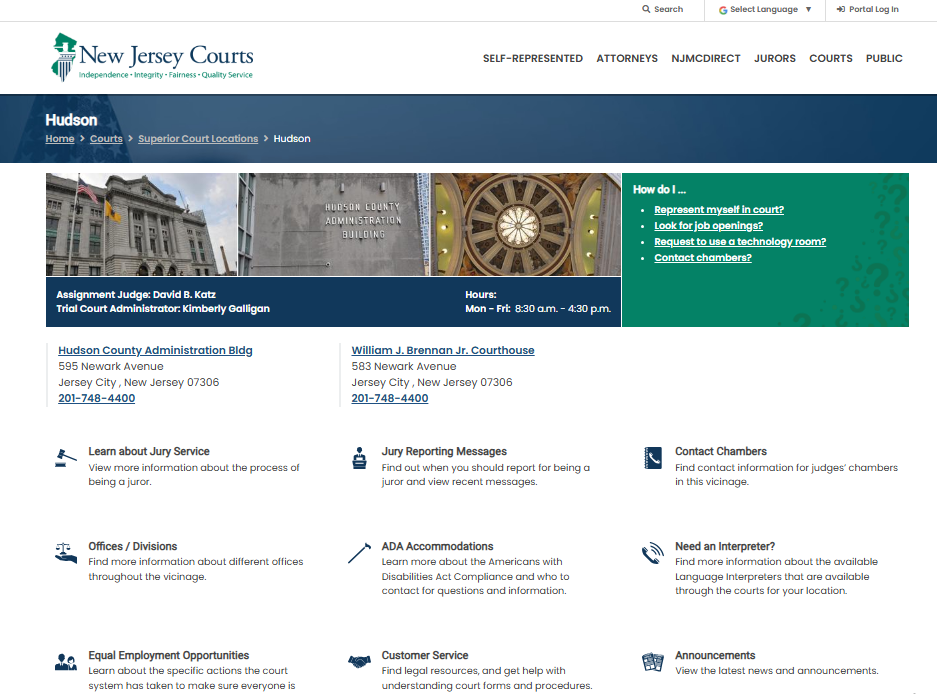
- Click Portal Log In at the top of the page
- Select Attorney Search (njcourts.gov)
- Enter the attorney’s name or license details
- View publicly available attorney information
This method allows a fast Monmouth Superior Court NJ online search without visiting the courthouse.
Viewing Records In-Person
The Records Department at the Monmouth County Courthouse provides access to filings and official copies. Key points:
- Bring a valid photo ID (driver’s license, state ID, or passport).
- Public access terminals are available for viewing electronic files.
- Copies of documents can be requested for a fee.
- Typical office hours: Monday–Friday, 8:30 a.m.–4:30 p.m.
Third-Party & Paid Services
Authorized third-party services offer Monmouth County case lookup for those who cannot access the courthouse directly.
- Databases provide filings, dockets, and case summaries.
- All services comply with NJ court rules and privacy laws.
- Fees vary depending on the document or level of detail requested.
Electronic Filing & Docket Monitoring
The JEDS eFiling system allows attorneys and self-represented litigants to submit filings electronically and monitor case progress. Benefits include:
- Real-time case status updates
- Notifications for new filings or scheduled hearings
- Reduced need for in-person visits
Cost and Access Options for Monmouth County Court Records
The following table summarizes the main ways to view or obtain records, along with typical costs:
| Access Method | Details | Typical Cost |
|---|---|---|
| NJ Courts Online Case Search | Free access to case summaries and filings | Free |
| In-Person at Courthouse | View files at Records Department; request copies | $0.50–$1.50 per page; $5–10 for certified copies |
| Third-Party Services | Online databases with case summaries and filings | Varies; usually $5–25 per document |
| eFiling / Docket Monitoring | Track case status and receive notifications | Free for registered users; filing fees may apply |
Monmouth Vicinage & Court Administration
The Monmouth Vicinage is the local branch of the Superior Court of New Jersey serving Monmouth County. It manages civil, criminal, family, and probate cases while overseeing court administration for the region.
In New Jersey, a vicinage refers to a geographic district of the Superior Court that organizes courts for efficient service and case management. Monmouth Vicinage operates under the state judiciary, ensuring cases are handled fairly and promptly. The court structure allows residents to access trial court services close to home while maintaining consistency with statewide judicial standards.
Court Leadership and Administration
The Monmouth Vicinage is led by several key officials who manage both judicial and administrative functions:
- Assignment Judge: Oversees the entire vicinage, sets policy, and ensures courts meet performance and procedural standards.
- Trial Court Administrator: Manages day-to-day operations, including scheduling, staffing, and resource allocation.
- Ombudsman Services: Assists the public with case questions, procedural guidance, and complaint resolution.
These leaders coordinate with other New Jersey Courts offices to maintain smooth operation across civil, criminal, family, and juvenile divisions. Their roles ensure cases progress efficiently and resources are available to the public.
Court Hours and Public Access
The Monmouth Vicinage maintains structured hours for public convenience:
| Service | Hours |
|---|---|
| Civil and Criminal Courts | Monday–Friday: 8:30 a.m.–4:30 p.m. |
| Family Court | Monday–Friday: 8:30 a.m.–4:30 p.m. |
| Clerk’s Office | Monday–Friday: 8:30 a.m.–4:30 p.m. |
Public access policies emphasize safety and order. All visitors must follow security procedures, and certain areas may require appointments. The courthouse is fully compliant with ADA requirements and offers interpreter services for individuals with limited English proficiency. This ensures that all residents can engage with the court system without barriers.
Monmouth County Superior Court — Court Divisions
The Monmouth County Superior Court manages different types of cases through specialized divisions. Each division focuses on particular legal matters to provide clear and efficient resolutions under New Jersey law.
Civil Division
The Civil Division handles disputes between individuals, businesses, and organizations, from small claims to large lawsuits. Cases in this division include claims under $20,000, handled by the Special Civil Part, as well as larger civil cases in the general Civil Part. The General Equity Part addresses non-monetary relief like injunctions or restraining orders. Filing starts with submitting a complaint to the clerk’s office, followed by service to defendants and scheduled hearings. Small claims cases often resolve in a few months, while larger matters can take a year or more. Court records are available online via the Monmouth County eCourts system or in person, and certified copies can be requested for a fee.
Criminal Division
The Criminal Division handles all criminal matters, ranging from minor offenses to serious felonies. It ensures that the legal process for indictable offenses and misdemeanors follows New Jersey statutes.
Felony vs Misdemeanor Process:
- Misdemeanors: Lower-level crimes such as petty theft, disorderly conduct, or minor drug offenses. Cases often involve arraignments, plea bargaining, and sentencing.
- Felonies: Serious offenses like burglary, assault, or major fraud. Felony cases involve pretrial hearings, grand jury indictments, trials, and sentencing.
Pretrial & Support Services:
- Pretrial services assess defendants’ risk and recommend conditions for release.
- The court may coordinate with probation, treatment programs, and rehabilitation services.
Expungement & Recovery Court:
- Monmouth County offers expungement processes for eligible convictions and arrests.
- Recovery Court programs support defendants with substance use disorders through structured treatment plans combined with court monitoring.
Family Division
The Family Division handles domestic, juvenile, and child-related legal issues. This division provides a structured approach to cases involving families, ensuring protection and fair resolutions.
Case Types:
- Custody & Visitation: Legal and physical custody arrangements for children.
- Divorce & Support: Spousal and child support enforcement, equitable distribution of property.
- Domestic Violence & Restraining Orders: Emergency and long-term protection orders.
- Juvenile Matters: Delinquency cases, dependency hearings, and probation supervision.
Procedural Steps:
- Filing a complaint or petition initiates the process.
- Mediation and preliminary hearings often occur before full trials.
- The court may involve social services or appointed guardians in complex cases.
Finance, Human Resources, IT, & Operations
The court relies on internal departments to maintain smooth operations and public service. Financial operations manage budgets, fees, and fines, while human resources handle staffing, training, and payroll. IT maintains case management systems, eFiling platforms, and cybersecurity. Operations and probation departments handle scheduling, recordkeeping, and supervision of offenders. Together, these divisions ensure that cases move efficiently and court services remain accessible.
Municipal Division’s Role
Municipal courts handle minor offenses and local ordinance violations within their limited jurisdiction. These courts address traffic violations, low-level criminal charges, and municipal code infractions. Court dockets in municipal courts provide a structured schedule of cases, listing hearings, parties involved, and case status, ensuring transparency and organization. Municipal courts issue fines, warnings, or short-term sentences. Cases beyond municipal court limits, like felonies or large civil disputes, are transferred to the Superior Court. This system allows the Superior Court to focus on more complex matters while providing residents with quick access to justice for smaller cases.
How to Navigate Court Services
Monmouth County Superior Court offers a variety of services to help residents participate in the judicial process and handle legal matters efficiently. Residents can access jury service information, request court records, file documents electronically, and use self-help resources to manage cases.
Jury Duty in Monmouth County
Jury service in Monmouth County is a civic responsibility, and residents will receive clear instructions on reporting and expectations. Jury reporting messages keep participants informed about their schedule and courtroom assignments.
Individuals summoned for jury service in Monmouth should check their notification for specific reporting times and call-in instructions. The court provides a dedicated phone line for reporting, along with an online portal to confirm attendance or check for schedule changes. During jury duty, participants may serve on civil, criminal, or family cases, contributing directly to the local justice system.
Key points for jury service:
- Call-in details: 24-hour phone line for schedule updates.
- Contact information: Jury office phone and email for questions.
- Expectations: Arrive on time, dress appropriately, and follow courtroom instructions.
- NJ Courts guidance: Provides resources explaining juror rights and obligations.
This process ensures fair representation in trials while offering clear instructions to reduce confusion for first-time jurors.
Court Records & Public Access
Residents can obtain court records in Monmouth County for civil, criminal, and family cases. The court maintains a public access system that allows users to request records online or in person, with fees depending on the type of document requested.
How to request records:
- Online search: Use the Monmouth County Records Search portal for basic case information.
- In-person requests: Visit the Records Department at the courthouse for complete files.
- Request fees: Some documents may require a nominal fee; payment options are accepted on-site or online.
Tips for efficient record access:
- Verify the case number or parties involved before requesting.
- Use filters in the online system to narrow results.
- Contact the Records Department for clarification or unusual requests.
Public access to court records ensures transparency and allows individuals to track case progress or obtain necessary legal documents without delay.
Electronic Filing & Forms
Monmouth County Superior Court supports eFiling through JEDS, the Judiciary Electronic Document System, enabling attorneys and self-represented litigants to file documents digitally. Electronic filing improves efficiency and reduces the need for in-person visits.
Process overview:
- Registration: Create a JEDS account on the NJ Courts website.
- Document preparation: Ensure all filings comply with court formatting rules.
- Submission: Upload documents and confirm receipt via the system.
- Notifications: Automated messages confirm filings and provide tracking numbers.
Practical tips for eFiling:
- Check document size limits before uploading.
- Keep a copy of the submission confirmation for records.
- Review JEDS tutorials or NJ Courts support for troubleshooting.
Electronic filing reduces paperwork and streamlines case management for both the court and participants.
Self-Help & Resource Centers
Monmouth County offers self-help resources and access to an ombudsman to assist residents with legal procedures. These services help people complete forms, understand procedural steps, and connect with community legal assistance.
Available support includes:
- Self-help centers: Provide printed forms, guidance on filling applications, and information on court procedures.
- Ombudsman assistance: Offers answers to questions about court processes and case management.
- Workshops and resources: Periodic sessions on family law, landlord-tenant disputes, and civil matters.
These services empower residents to handle legal matters with confidence while ensuring the process remains approachable and organized.
Practical Information for Court Visitors
Quick answer: The Monmouth County Superior Court at 71 Monument St in Freehold, NJ, is open Monday through Friday from about 8:30 a.m. to 4:30 p.m. This section gives clear details on the courthouse address, Monmouth County Superior Court hours, parking, directions, and accessibility so visitors can plan their visit with confidence.
Whether someone is attending a hearing, filing court papers, or serving on a jury, having accurate courthouse address details and parking options makes the visit easier. The main building sits in central Freehold, close to public transit and marked by the historic county courthouse steps.
Court Location & Hours
Address:
Monmouth County Superior Court
71 Monument St
Freehold, NJ 07728
Monmouth County Superior Court hours:
- Monday – Friday: 8:30 a.m. to 4:30 p.m.
- Saturday & Sunday: Closed
These are the standard business hours for court offices, such as civil, criminal, and probate services.
Phone: (732) 358‑8700 (useful for confirming hours or asking about specific services).
Map Directions & Parking
Visitors can reach the courthouse by car or by local bus service. Major roads like Route 33 and local county routes lead into Freehold town center. Ample public parking is available behind the courthouse and on adjacent streets, though some spaces are restricted during peak hours. On‑street parking rules can vary, so allow time to find a legal spot.
Nearby transit options:
- NJ Transit and Monmouth County bus routes stop close to the building.
- Bus riders should check schedules ahead of time and request lifts for wheelchair access if needed.
Accessibility Information
The courthouse offers wheelchair access with entrances and restrooms compliant with ADA standards. Elevators serve multiple floors. If special assistance or an interpreter is needed, call the court office before the visit to confirm support.
(FAQ) About Superior Court
The Monmouth County Superior Court handles a wide range of cases, including civil, criminal, family, and probate matters, providing residents with access to hearings, case information, and jury service.
What types of cases does the Monmouth County Superior Court handle?
The court hears civil disputes, criminal prosecutions, family law matters, and probate cases, making it the main judicial authority in the county. Civil cases include contract disagreements, property claims, personal injury suits, and tort actions, while family cases cover divorce, child custody, and support issues. Criminal matters range from minor offenses to serious felonies, and probate cases involve the administration of wills, estates, and guardianships. The Superior Court also hears appeals from municipal courts, ensuring that more complex or significant legal matters are addressed at a higher level.
How do I find my case docket?
Residents can check the status of their cases through the Monmouth County Superior Court’s official online portal or by visiting the courthouse in person. Dockets provide information about scheduled hearings, past actions, case numbers, and the parties involved, allowing participants to track the progress of their legal matters. While the online database provides basic details for free, full access to filings and documents may require a small fee at the Records Department, giving users the ability to review complete case histories and upcoming court dates.
Can I represent myself in Monmouth County Superior Court?
Individuals have the option to represent themselves, known as acting as a pro se litigant, in civil or other eligible cases. While the court allows self-representation, it is important to follow all filing requirements, meet deadlines, and attend hearings on time. Court staff can explain procedural steps, but they cannot provide legal advice, so self-represented litigants may benefit from consulting legal aid organizations or attorneys for guidance on more complex issues. Representing oneself requires careful preparation and attention to court rules to ensure the case proceeds smoothly.
What’s the difference between the Superior Court and the municipal court?
Municipal courts generally handle minor criminal offenses, traffic violations, and local ordinance cases, whereas the Superior Court deals with major civil, criminal, family, and probate matters. Appeals from municipal court decisions are typically heard in the Superior Court, which has broader authority to address more serious legal issues. While municipal courts focus on smaller, community-level matters, the Superior Court ensures comprehensive oversight for significant disputes, legal conflicts, and family or estate matters within Monmouth County.
How do I file an appeal?
Appeals from municipal or lower court decisions are filed in the Monmouth County Superior Court, which reviews the proceedings of the lower court to determine if errors were made. Filing an appeal involves submitting a notice of appeal within the legal deadline, providing a record of the lower court case, and following the procedural rules for briefs and hearings. Once the appeal is filed and all parties are notified, the court schedules the case for review, ensuring that decisions are evaluated fairly and in accordance with the law.