
Monmouth County Court serves as the main trial court for Monmouth County, New Jersey. It operates within the New Jersey Superior Court system and acts as the central judicial authority for the county. The court manages civil, criminal, family, and probate cases that directly impact residents, businesses, and local agencies. Judges oversee filings, hearings, and rulings according to state law and uniform court rules. Its organized structure ensures cases proceed efficiently while maintaining fairness and transparency. Residents and attorneys rely on Monmouth County Court, NJ, for consistent and reliable judicial services.
Monmouth County Court, NJ, is an integral part of the county judiciary and the larger New Jersey court system. It operates through specific divisions, including civil, criminal, family, and probate, to handle different types of cases. Each division follows standardized procedures that support timely resolutions and orderly court operations. By working within the Superior Court framework, the court maintains accountability and public confidence. Its clear processes and dedicated judges make it a trusted authority for legal matters in Monmouth County. The court’s presence ensures accessible, professional, and consistent justice across the county.
What is the Monmouth County Court System
The Monmouth County Court System functions as part of the New Jersey court system, handling a wide range of civil, criminal, and family matters at the county level. It operates within a structured county judiciary that links local courts to statewide judicial administration.

The Monmouth County Court serves residents through an organized framework set by New Jersey’s unified judiciary. The county court’s structure follows statewide rules, procedures, and case management standards. This shared model supports consistent rulings and predictable court processes across New Jersey. At the same time, each county plays a defined role that reflects local needs and caseloads.
How County Courts Operate in New Jersey
New Jersey uses a unified court system, meaning county courts operate under state authority rather than local government control. Judges receive state appointments, and the Administrative Office of the Courts oversees operations. This setup keeps court practices consistent across counties.
Within Monmouth County Court, cases flow through divisions of the Superior Court, which include:
- Criminal Division for indictable offenses
- Civil Division for disputes, lawsuits, and damages
- Family Division for divorce, custody, and juvenile matters
- General Equity and Probate for estates and complex filings
Each division follows the same NJ court structure used statewide. For example, filing deadlines, hearing formats, and judicial titles match those in other counties. As a result, users moving between counties see familiar court procedures.
What “Vicinage” Means in the County Judiciary
New Jersey organizes counties into regional court groupings called vicinages. A vicinage includes one or more counties that share administrative resources and judicial leadership. Monmouth County belongs to Vicinage 9, which it shares with Ocean County.
This vicinage model supports efficient court management by:
- Sharing assignment judges and administrative staff
- Coordinating calendars across counties
- Applying uniform policies within the region
For court users, vicinage placement explains why some administrative offices or judicial orders serve more than one county.
How to Access Monmouth County Court Records and Cases
Court records in Monmouth County provide public details on civil, criminal, family, and probate cases. Individuals seeking case information in NJ can find records online or at courthouse offices.
How to Search Monmouth County Court Records
Residents and researchers can use the Monmouth County Online Public Records Search (OPRS) to access a variety of court records in Monmouth County. This official system provides details on civil, criminal, family, and probate cases.
- Go to the OPRS Portal: Visit https://oprs.co.monmouth.nj.us/oprs/CustomSearch/SearchInput.aspx?iId=486. The search page will display fields for plaintiff and defendant information, town, and plea year.
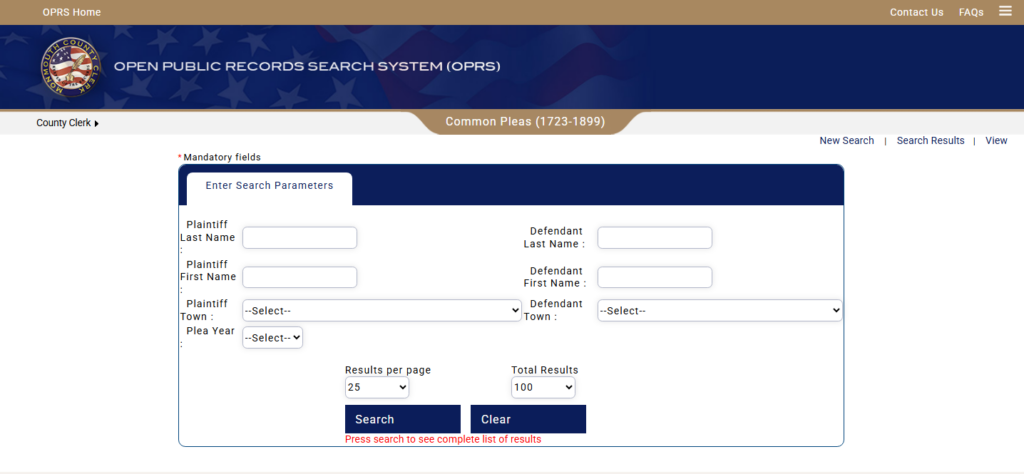
- Enter Search Parameters:
- Plaintiff Last Name / First Name: Enter the name of the party who filed the case.
- Defendant Last Name / First Name: Enter the opposing party’s name if known.
- Plaintiff / Defendant Town: Select the town associated with the party.
- Plea Year: Choose the year the case was filed (if known) to narrow results.
- Set Results Preferences:
- Results per Page: Choose how many cases to display per page.
- Total Results: Select the maximum number of results to retrieve.
- Search and Review: Click Search to view matching cases. The system will display a list of cases with relevant details such as case number, parties, and court events.
- Accessing Documents: Some documents may be downloaded for a fee, usually around $5 per document. For full case files or certified copies, visit the Monmouth County Records Department in person.
Where to View Records
Monmouth County provides multiple ways to view court records:
- Online Databases: Free for basic case information; some documents can be purchased through the OPRS or New Jersey Courts Public Access system.
- Monmouth County Courthouse: Access full case files at the Records Department, ideal for detailed filings and certified copies.
- Third-Party Services: Obtain downloadable court documents or case summaries for a fee, useful when remote access is needed.
Cost of Accessing Records
Fees vary depending on the method and document type. The table below summarizes typical costs:
| Method | What You Can Access | Cost |
|---|---|---|
| Online via NJ Courts Public Access / OPRS | Basic case information, some downloadable documents | Free–$5 per document |
| Monmouth County Courthouse (Records Department) | Full case files, civil, criminal, family, probate | $0.50 per page photocopy; $5–$10 for certified copies |
| Third-Party Services | Downloadable court documents, case summaries | $10–$25 per document |
Courts Operating in Monmouth County, New Jersey
Monmouth County Court, NJ, oversees a variety of legal matters, ranging from minor municipal offenses to complex civil, criminal, and family cases. The county’s court system combines the Superior Court – Monmouth Vicinage and local municipal courts to ensure residents have access to specialized judicial services. The courts are organized into divisions based on case type. Each division is designed to handle specific matters efficiently, allowing judges and staff to provide consistent and fair outcomes.
Superior Court of New Jersey – Monmouth Vicinage
The Superior Court – Monmouth Vicinage serves as the main trial court for serious civil, criminal, and family cases in the county. This court has broad authority to hear cases that municipal courts cannot, making it central to Monmouth County’s legal system. The court handles high-stakes cases, including large monetary disputes, indictable criminal offenses, and intricate family law matters. Decisions from this court can be appealed to the New Jersey Appellate Division, providing a clear path for legal review.
Civil Division
The Civil Division focuses on legal disputes between individuals, businesses, or organizations, typically involving monetary claims or contractual disagreements. Cases in this division often exceed small claims limits handled in municipal courts, making the Superior Court the appropriate venue.
Civil Division details:
- Types of Cases: Breach of contract, property disputes, and personal injury claims.
- Monetary Thresholds: Generally hears cases where claims exceed $15,000; smaller claims go to small claims court.
- Processes: Includes pre-trial mediation, discovery, and jury or non-jury trials.
This division aims to provide fair resolution through structured hearings and rulings guided by New Jersey law.
Criminal Division
The Criminal Division handles serious offenses, including indictable crimes that carry significant penalties. It works closely with county prosecutors who review evidence, file charges, and represent the state during trials.
Criminal Division responsibilities:
- Indictable Offenses: Includes robbery, assault, burglary, and other felony-level crimes.
- Prosecutors’ Role: Present the case on behalf of the state, manage plea agreements, and oversee grand jury proceedings.
- Court Procedures: Includes arraignments, pre-trial hearings, trials, and sentencing.
This division ensures that justice is served while maintaining legal standards and protecting defendants’ rights.
Family Division
The Family Division addresses cases that impact the personal and familial lives of county residents. Judges in this division handle sensitive matters requiring discretion and adherence to state family laws.
Family Division cases include:
- Divorce and property settlement disputes
- Child custody and visitation arrangements
- Child and spousal support
- Domestic violence and family court injunctions
Hearings in this division often involve mediation sessions and court-ordered agreements to resolve conflicts efficiently.
Municipal Courts in Monmouth County
Municipal courts address violations of local ordinances and minor criminal offenses. Each municipality in Monmouth County operates its own court to manage these lower-level cases efficiently. These courts handle traffic violations, zoning disputes, noise complaints, misdemeanors, and other minor infractions. Processes often involve hearings, fines, community service, or probation. By managing less serious matters locally, municipal courts allow the Superior Court to focus on complex civil, criminal, and family cases.
Jurisdiction and Authority of Monmouth County Court
The Monmouth County Court holds legal authority over specific types of cases within its designated geographic area. Its jurisdiction defines both where and over what matters the court can exercise legal control.
Geographic Jurisdiction
Monmouth County Court serves the entire Monmouth County, New Jersey, including all municipalities within the county’s boundaries. This means any legal case arising within Monmouth County—whether civil, criminal, or family-related—falls under its authority. Geographic jurisdiction ensures that residents and entities within the county have a local venue for resolving disputes efficiently. Municipal courts, in contrast, handle cases only within their individual towns or cities and typically deal with minor offenses, traffic violations, or local ordinance issues.
Key points about geographic jurisdiction:
- Covers all 53 municipalities in Monmouth County
- Ensures local access to county-level justice
- Differentiates county court authority from municipal courts
Subject-Matter Jurisdiction
Monmouth County Court’s authority is not limited by location alone; it also extends to specific types of cases. Subject-matter jurisdiction refers to the court’s power to hear certain legal issues, including:
- Civil cases: Disputes involving contracts, property, or personal injury above a certain monetary threshold
- Criminal cases: Felonies and serious misdemeanors occurring within the county
- Family matters: Divorce, child custody, and support cases
- Probate and estate issues: Wills, trusts, and guardianship matters
Unlike municipal courts, which handle minor infractions and local ordinance violations, Monmouth County Court has broader authority to resolve complex civil and criminal cases. This specialization allows the county judiciary to provide consistent and expert legal decisions.
Differences Between County and Municipal Authority
County and municipal courts in New Jersey differ in both scope and function:
| Feature | Monmouth County Court | Municipal Court |
|---|---|---|
| Geographic Coverage | Entire county | Individual municipality |
| Case Types | Civil, criminal, family, probate | Traffic violations, minor criminal offenses, local ordinances |
| Legal Authority | Broader, includes felony and larger civil cases | Limited, minor cases only |
| Judges | Superior court judges or appointed county judges | Municipal judges or magistrates |
Legal Process in Monmouth County Court Step
The legal process in Monmouth County Court follows a structured sequence that ensures fairness and clarity for all parties. From filing a case to receiving a judgment, each stage has defined procedures under New Jersey law.
Filing a Case
The first step in any legal process in NJ begins with filing a complaint or petition. Individuals must submit required forms at the Monmouth County Court clerk’s office, paying applicable filing fees.
Documents typically include:
- Complaint or petition outlining the legal issue
- Summons for notifying the opposing party
- Supporting evidence or attachments
Once filed, the court assigns a case number, which becomes the reference for all future proceedings. Filing correctly is essential to prevent delays or dismissal.
Case Assignment
After filing, the case is assigned to a judge based on the court’s scheduling and specialty. Cases may be directed to civil, criminal, or family court divisions, depending on the matter.
During this stage:
- The court sets preliminary dates for hearings or motions
- Parties may receive notices for mandatory mediation or conferences
- Case management orders outline deadlines for filings and responses
This ensures cases progress efficiently while giving all parties time to prepare.
Hearings and Motions
Once assigned, the court may schedule hearings or motions before a trial. This allows parties to address legal disputes, procedural issues, or requests for temporary relief.
Common examples include:
- Motions to dismiss or amend a case
- Requests for temporary orders (child custody, restraining orders)
- Status conferences to review case progress
Hearings often involve oral arguments, evidence presentation, and court rulings, helping narrow issues for trial.
Trials
If the dispute is unresolved, the case moves to trial. Trials in Monmouth County Court can be bench trials (decided by a judge) or jury trials (decided by a jury).
During trial:
- Both sides present evidence and witness testimony
- Legal arguments are made in accordance with NJ legal procedures
- The court ensures rules of evidence and fairness are observed
Trials provide a formal setting where decisions are based on facts and applicable law.
Judgments and Resolutions
After the trial, the court issues a judgment or resolution. This final stage determines rights, responsibilities, or penalties.
Key points include:
- Written orders detailing decisions and obligations
- Possible appeals within specified timeframes
- Enforcement of judgments through garnishments, liens, or other legal remedies
Resolutions provide closure and enforceable outcomes, completing the legal process in Monmouth County.
Summary Table: Legal Process Steps in Monmouth County Court
| Step | Description | Key Points |
|---|---|---|
| Filing a Case | Submit complaint/petition | Case number assigned, filing fees required |
| Case Assignment | Written judgment, enforcement, and appeals are possible | Preliminary dates and case management orders |
| Hearings & Motions | Address procedural or legal issues | Motions, temporary orders, status conferences |
| Trial | Present evidence and arguments | Bench or jury trial, witness testimony |
| Judgments & Resolutions | Court decision issued | Written judgment, enforcement, and appeals are possible |
Judges and Court Officials in Monmouth County
Judges in Monmouth County Court play a central role in ensuring justice is served fairly and efficiently. They oversee legal proceedings, make rulings on cases, and uphold the integrity of the county judiciary. The Monmouth County Court system relies on a team of judicial officers, including judges, magistrates, and clerks, who each have specific responsibilities. Judges in Monmouth County Court preside over civil, criminal, family, and probate matters, interpreting laws and applying them to individual cases. Their decisions can influence the outcomes of trials and the enforcement of legal rights within the county.
Court officials support judges in their daily functions. Magistrates handle preliminary hearings, motions, and minor cases, helping to reduce the judges’ workload. Court clerks manage case files, schedule hearings, and maintain public records. Bailiffs ensure courtroom security and assist with enforcing court orders. Together, these roles form the backbone of the county judiciary, ensuring that proceedings run smoothly and efficiently.
Key Roles of Judicial Officers
- Presiding Judges: Lead the court in hearings and trials, make rulings, and manage courtroom procedures.
- Magistrates: Oversee preliminary matters, small claims, and procedural hearings.
- Court Clerks: Maintain official records, manage case documents, and provide administrative support.
- Bailiffs: Maintain safety in the courtroom, assist judges, and manage the flow of proceedings.
Judges in Monmouth County Court are appointed or elected based on their legal experience and knowledge of New Jersey law. Their decisions reflect both the letter of the law and careful consideration of each case’s circumstances. By working closely with court officials, judges help maintain public trust in the county judiciary while delivering fair and impartial justice.
How Monmouth County Court Fits into the New Jersey Court System
Monmouth County Court is an integral part of the New Jersey court system, handling a wide range of civil, criminal, and family matters. It operates under the authority of the state judiciary, working alongside other trial and appellate courts to ensure justice is administered fairly and efficiently.
The New Jersey court system is structured in multiple levels. At the top is the New Jersey Supreme Court, which handles appeals and significant legal questions affecting the entire state. Beneath it are the Appellate Division of the Superior Court and the trial courts, which include the Superior Court, Municipal Courts, and specialized divisions. Monmouth County Court primarily functions as a trial court, resolving cases that involve residents and enforcing state laws within the county.
Key roles of Monmouth County Court within this system include:
- Civil Cases: Resolving disputes such as contracts, personal injury claims, and property issues.
- Criminal Cases: Handling offenses ranging from misdemeanors to serious felonies at the trial level.
- Family Matters: Overseeing divorce, child custody, and domestic violence cases.
- Probate and Estate Issues: Managing wills, estates, and guardianships.
The court collaborates with other divisions of the state judiciary, ensuring that decisions can be appealed to higher courts when necessary. This interaction helps maintain consistency across New Jersey and allows citizens to seek further review if a trial court ruling is contested.
Table: Monmouth County Court within the New Jersey Court System
| Level of Court | Role | Examples of Cases Handled |
|---|---|---|
| Supreme Court | Highest appellate court | Constitutional issues, appeals from lower courts |
| Appellate Division | Intermediate appellate review | Appeals from Superior Court |
| Superior Court (Trial Division) | County-level trials | Civil, criminal, family, probate |
| Monmouth County Court | Local trial court | Misdemeanors, civil claims, family disputes |
| Municipal Courts | Local ordinance violations | Traffic tickets, minor offenses |
Monmouth County Courthouse Locations & Administration
The Monmouth County courthouse sits at 71 Monument Street, Freehold, NJ 07728, and serves as the primary legal and administrative center for the county’s court system. It supports judicial offices, clerk services, and public administrative departments that help manage court filings and case activity.
The courthouse handles many types of legal matters, including civil, criminal, family, special civil, and jury-related services. Court administration staff and clerks work together to keep records, schedule hearings, and assist the public with filings, questions, and court procedures.
Main Courthouse Location & Contact
Here are the key details for the county’s central court facility:
Court Name: Monmouth County Superior Court
- Address: 71 Monument Street, Freehold, NJ 07728
- Phone: (732) 358‑8700
- Hours: Monday–Friday, 8:30 a.m. – 4:30 p.m.
- Jury Office Email: Monjury.Mailbox@njcourts.gov
- Self‑Help/Resource Email: MonmouthHelp.mailbox@njcourts.gov
- Zip Code: 07728
This courthouse location houses the Superior Court and many of its judicial divisions. The facility also includes key administrative offices that support case processing, records management, and coordination of jury services.
Judicial Offices & Court Administration
Inside the courthouse, several judicial and administrative roles work to keep court operations running smoothly:
- Assignment Judge: Oversees court operations countywide.
- Trial Court Administrator: Manages daily administrative tasks and court staff.
- Presiding Judges: Lead divisions such as civil, criminal, family, and special civil.
- Jury Management Office: Coordinates juror summons, scheduling, and related communications.
Court administration staff assist with scheduling hearings, managing dockets, and serving as liaisons between the public and judges. These offices help ensure that clerical tasks and procedural steps are completed correctly.
Clerk & Support Services
Administrative support offices provide essential services to the public and legal professionals, including:
- Clerk of Court Services: Records filings, issues summons, and maintains official court documents.
- Jury Services: Manages all juror communications and instructions.
- Public Counters: Offer filing assistance, form requests, payment of fines, and general support for court users.
Most services are available during regular business hours. Call ahead or send an email to the appropriate office to confirm availability or to ask specific questions related to your case.
Frequently Asked Questions About Monmouth County Court
Residents and attorneys often have questions about how the Monmouth County Court in New Jersey operates, what cases it handles, and how court procedures work. The following FAQs provide clear and concise answers to common inquiries about local legal matters.
What types of cases does Monmouth County Court handle?
Monmouth County Court, NJ, handles civil, criminal, family law, small claims, and traffic matters, giving residents local access to hearings and legal proceedings. The court manages disputes over contracts, property, or personal injury, as well as misdemeanors and preliminary hearings for serious criminal cases, while family matters such as divorce, child custody, and domestic issues are handled within the family division. Small claims and landlord-tenant matters receive attention, and traffic violations or local ordinance issues are addressed routinely, all following the legal process in NJ to ensure fair hearings and orderly resolution.
Is Monmouth County Court the same as the Superior Court?
Monmouth County Court is part of New Jersey’s judicial system, but it is not the same as the Superior Court, as it primarily handles lower-level civil, criminal, and family cases before more serious matters reach the Superior Court. It focuses on local hearings for misdemeanors, minor civil disputes, and preliminary criminal proceedings, while the Superior Court deals with major civil trials, criminal cases, and equity matters. Appeals from Monmouth County Court may be reviewed by the Superior Court, connecting local cases to the statewide judiciary and allowing residents to resolve most matters locally before escalating.
Where are cases filed?
Cases are filed at the Monmouth County Courthouse at 1 East Main Street in Freehold, New Jersey, with divisions for civil, criminal, and family matters. Civil cases go to the civil division, criminal cases to the criminal division, and family cases to the family part, with filings accepted in person, by mail, or electronically, depending on the type of case. Court staff guide required forms and supporting documents, helping residents submit filings correctly and ensuring the process aligns with local court procedures.
How long do cases take?
Case durations in Monmouth County Court vary depending on type and complexity, ranging from a few weeks for minor traffic violations to several months or longer for civil or family disputes. Criminal trials typically proceed faster than complex civil cases involving multiple parties, while pre-trial requirements such as document submission, mediation, or procedural motions can extend timelines. The court schedules hearings based on availability, and small claims often conclude within a few months, giving residents a predictable yet flexible timeline for resolving local legal matters.
Who can access court records?
Court records in Monmouth County are generally public, but some sensitive cases are restricted, including adoptions and juvenile matters that require special permission. Accessible records include filings, judgments, and decisions, and can be viewed at the courthouse or requested in writing, with some documents available online. The court balances transparency in the legal process in New Jersey with privacy protections, allowing parties, attorneys, and the public to review information while keeping certain records confidential when necessary.