
The Monmouth County Family Court serves as the central hub for resolving family law matters in New Jersey’s Monmouth County. As part of the NJ Superior Court Family Division, this court handles a wide range of cases, including child custody cases, divorce proceedings, and support cases. Residents rely on the court for authoritative guidance on legal processes that impact families, from establishing paternity to enforcing support orders. Understanding how this court operates ensures that families can navigate sensitive matters with clarity and confidence.
Whether you are filing for divorce, seeking custody, or addressing domestic relations issues, the family court in Monmouth County, NJ, provides structured procedures and essential resources to support you. The Monmouth County Court Domestic Relations Court offers access to forms, hearings, and self-help services designed to simplify complex legal processes. By familiarizing yourself with the court’s functions, procedures, and resources, you can take informed steps toward resolving disputes efficiently while safeguarding your rights and the best interests of your family.
Monmouth County Family Court
The Monmouth County Family Court handles legal matters related to families and children in Monmouth County, New Jersey. It is part of the New Jersey Superior Court, Family Division, responsible for resolving disputes and protecting the rights of family members.
Role and Function of Monmouth County Family Court
The Monmouth County Family Court oversees cases involving divorce, child custody, child support, domestic violence, guardianship, and adoption. Its mission is to provide fair decisions while prioritizing the well-being of children and families. This court ensures that family law issues are addressed efficiently and according to New Jersey law.
Some key responsibilities include:
- Divorce and Separation: Determining equitable distribution of assets, alimony, and spousal support.
- Child Custody and Parenting Time: Establishing arrangements in the best interest of the child.
- Child Support: Calculating and enforcing support payments.
- Domestic Violence Cases: Issuing restraining orders and protection measures.
- Adoption and Guardianship: Approving legal arrangements for minors and dependents.
How It Fits Within the New Jersey Judicial System
The Monmouth County Family Court operates as the Family Division of the Superior Court of New Jersey. The New Jersey court system is structured into three main levels:
- Supreme Court: The highest appellate court in New Jersey.
- Appellate Division of the Superior Court: Reviews decisions from lower courts.
- Superior Court (Law, Chancery, and Family Divisions): Handles civil, criminal, and family law matters.
Within this structure, the Family Division specifically focuses on family-related disputes. Judges in the Family Court apply state laws and local rules to ensure fair outcomes. Their decisions can affect parental rights, financial responsibilities, and child welfare.
How to Search Monmouth County Family Court Records
Monmouth County Family Court records can be accessed online or in person, depending on the type of case and the level of detail needed. Users can check case status, review filings, and request official documents using both methods.
Searching correctly ensures accurate results and saves time. The most efficient approach is to start with the New Jersey Courts Public Access System (OPRS) for online searches, then use the courthouse records office for restricted or certified documents.
Online Records Search
The easiest way to search for Monmouth County Family Court records is through the Monmouth County Court Public Access Portal. This portal allows users to search by party name, case number, or attorney details and view summaries of family law cases, including divorce, child custody, support, and domestic relations.
Steps to Search Online:
- Go to the link: https://oprs.co.monmouth.nj.us/oprs/CustomSearch/SearchInput.aspx?iId=486
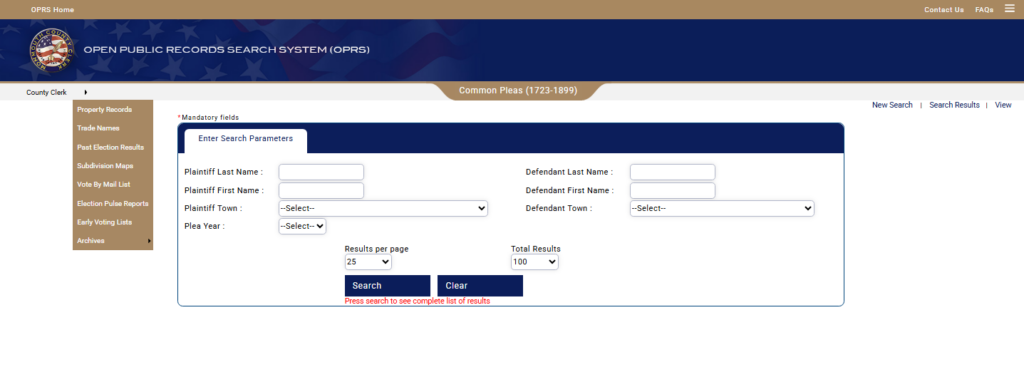
- Plaintiff Last Name — Enter the last name.
- Plaintiff First Name — Optional, enter if known.
- Defendant Last Name / First Name — Enter if available.
- Plaintiff Town / Defendant Town — Select from the dropdown.
- Search Button — Click Search after filling the form.
- Results — Matching records will be displayed.
- New Search — Click New Search to perform another search
Tips for Online Searches:
- Use the exact spelling of names to improve accuracy.
- Check for alternate spellings or middle initials.
- Some records, such as child custody or domestic violence cases, are restricted and cannot be viewed online.
Costs for Online Access:
- Basic search: Free
- Downloaded case documents: $0.50–$1 per page (depending on document type)
In-Person Records Search
For records not available online or for certified copies, users can visit the Monmouth County Family Court Records Office.
Courthouse Information:
- Address: 71 Monument Street, Freehold, NJ 07728
- Phone: (732) 431-7300
- Hours: Monday–Friday, 8:30 AM–4:30 PM
What You Can Do In-Person:
- Access physical case files
- Request certified copies
- Receive assistance with forms and record requests
In-Person Search Tips:
- Bring a government-issued ID.
- Know the case number or the full names of the parties.
- Check court hours before visiting.
Costs for In-Person Requests:
- Certified copy of a court document: $2–$10 per page
- Copying or printing fees: $0.25–$1 per page
Types of Records Available
Users can access various family court records, including:
- Divorce filings and decrees
- Child custody agreements and modifications
- Child and spousal support orders
- Domestic violence restraining orders
Case Type Codes for Reference:
- FM – Family Matters
- FD – Divorce
- FV – Domestic Violence
- FN – New Support Cases
- FO – Other Family Orders
- FJ – Juvenile Family Cases
Requesting Certified Copies
Certified copies are official documents needed for legal or personal purposes.
Steps to Request Certified Copies:
- Submit a written application to the Family Court Records Office.
- Include case numbers and party names.
- Pay the required fees.
Certified copies are legally recognized for filings, government requests, or personal documentation.
What Cases Does Monmouth County Family Court Handle?
Monmouth County Family Court handles cases related to family relationships, including divorce, child custody, support, and domestic violence matters. The court also oversees adoption, guardianship, and juvenile issues.
Divorce Proceedings
The Family Court has authority over all divorce cases filed in Monmouth County. This includes contested and uncontested divorces, where spouses either agree or disagree on issues such as property division, child custody, and spousal support.
Key elements in divorce cases include:
- Equitable Distribution: The fair division of marital property and debts based on factors like contributions, income, and length of marriage.
- Alimony/Spousal Support: Temporary or permanent payments may be awarded to a spouse based on financial need, earning capacity, and standard of living during the marriage.
Law firms such as Rudnick Law highlight that clear documentation and accurate financial disclosures can streamline proceedings and reduce delays.
Child Custody Cases
Child custody cases in Monmouth County focus on both legal custody (decision-making rights) and physical custody (where the child lives). The court prioritizes the best interests of the child, considering factors like parental involvement, child safety, and the child’s preferences when age-appropriate.
Common issues include:
- Parenting Time: Schedules for visitation and time spent with each parent.
- Relocation: Legal restrictions apply if a parent plans to move, potentially affecting custody arrangements.
Family law offices, such as Murray Family Law Offices, note that mediation often helps parents reach agreements without prolonged litigation, saving time and reducing stress for children.
Support Cases
Support cases involve both child support and spousal support. The Family Court enforces financial obligations and ensures that payments meet legal guidelines.
Important aspects:
- Child Support Enforcement: Ensures timely and full payment to cover a child’s basic needs, education, and healthcare.
- Paternity Establishment: Legal recognition of a parent-child relationship, which can trigger support obligations.
- Spousal Support Overview: Financial support may continue post-divorce depending on income, marriage duration, and each spouse’s needs.
According to resources like Visit Monmouth, proper documentation and adherence to court schedules are critical for smooth case management.
Domestic Violence & Restraining Orders
The Family Court handles requests for temporary and final restraining orders to protect victims of domestic violence. Individuals can file petitions to prevent abuse, harassment, or threats.
Key points:
- Temporary Restraining Orders (TROs): Short-term protection while the court reviews the case.
- Final Restraining Orders: Long-term court orders providing ongoing protection.
- Filing Locations: Petitions are submitted directly to Family Court, often through the court clerk’s office.
Law firms like LLF Law Firm emphasize bringing evidence, witness statements, and documentation to strengthen petitions and ensure immediate safety.
Other Family Law Matters
Beyond divorce and custody, the Family Court also oversees:
- Adoption: Legal transfer of parental rights to a new guardian.
- Guardianship: Appointment of a responsible adult for minors or incapacitated adults.
- Juvenile Matters: Cases involving minors, including delinquency and status offenses.
- Abuse & Neglect: Court interventions to protect children at risk.
These cases often involve social services, court-appointed advocates, and multiple hearings to protect the interests of vulnerable parties.
The Family Court Docket Types
Family Court cases in Monmouth County are organized by specific docket codes that indicate the type of legal matter being addressed. These codes help attorneys, court staff, and the public quickly identify the nature of a case. Monmouth County Family Court, NJ, uses several key docket types, each corresponding to a distinct area of family law. Marriage & Divorce Records are an essential part of this system, providing official documentation for individuals seeking information about marital status or legal dissolution. Menar & Menar Attorneys at Law frequently handle cases across these dockets, including divorce, child protection, domestic violence, and juvenile matters.
Common Docket Codes in Monmouth County
Here are the main docket types used in Monmouth County Family Court, along with what each involves:
- FM (Divorce / Dissolution Cases)
- Handles legal dissolutions of marriage.
- Includes issues like division of property, spousal support, and child custody.
- Both contested and uncontested divorces appear under this docket.
- FD (Non‑Dissolution Family Matters)
- Covers family-related disputes that do not involve ending a marriage.
- Examples include parental rights, custody modifications, visitation issues, and guardianship cases.
- FV (Domestic Violence / Restraining Orders)
- Manages cases involving protection against abuse, harassment, or threats.
- Includes temporary restraining orders (TROs) and final restraining orders (FROs).
- Focuses on immediate safety concerns and legal protections.
- FN (Child Protection / Abuse & Neglect Cases)
- Addresses situations where a child’s welfare may be at risk.
- Includes investigations by child protective services, foster care decisions, and parental supervision matters.
- The court prioritizes the child’s safety and well-being in all decisions.
- FO (Family Court Violations)
- Deals with violations of prior court orders.
- Common examples include failure to pay child support, violation of visitation agreements, or ignoring restraining orders.
- FJ (Juvenile Cases)
- Covers minors involved in legal matters, including delinquency, rehabilitation, and probation issues.
- Focuses on corrective measures rather than punishment, aiming to address behavioral concerns.
How Docket Types Affect Court Process
Each docket type follows specific procedures, hearing schedules, and documentation requirements. Knowing the correct docket code ensures that filings are processed efficiently and assigned to the appropriate court division. Attorneys like Menar & Menar help clients prepare the necessary paperwork, represent them during hearings, and explain procedural requirements for each docket.
Quick Reference Table: Monmouth County Family Court Dockets
| Docket Code | Case Type | Key Matters |
|---|---|---|
| FM | Divorce / Dissolution | Property division, child custody, spousal support |
| FD | Non-Dissolution Family | Custody changes, guardianship, parental rights |
| FV | Domestic Violence | Restraining orders, harassment protection |
| FN | Child Protection | Abuse, neglect, foster care, supervision |
| FO | Violations | Court order enforcement, child support, visitation |
| FJ | Juvenile | Delinquency, probation, rehabilitation programs |
How to File a Case & Court Procedures
Filing a case in Monmouth County Family Court begins with completing the correct forms and submitting them to the Family Division. A complaint may involve custody, child or spousal support, or domestic violence, and must be filed either in person at the Freehold courthouse or through the NJ Courts e-filing system. Required forms include the Complaint for Custody or Parenting Time, Complaint for Child or Spousal Support, and, if necessary, a Domestic Violence Complaint. Filing early, keeping copies, and including applicable court fees can prevent delays.
Responding & Motions
After a complaint is filed, the opposing party must respond within the court’s timeline using an Answer form and may include supporting documents such as financial records or custody agreements. Additional requests, or motions, can be filed for custody modifications, support adjustments, or emergency relief, and the judge may schedule hearings if further discussion is required. Prompt and complete responses help the court make informed decisions, while motions ensure both parties can address changes or urgent needs efficiently.
Filing a Complaint
To begin a case, an individual must file a complaint with the Family Division of the Superior Court in Monmouth County. Complaints can cover issues like custody, child or spousal support, or domestic violence. The complaint explains the situation and requests that the court take action.
The forms needed depend on the type of case:
- Complaint for Custody or Parenting Time – for arranging child custody or visitation.
- Complaint for Child or Spousal Support – to request financial support.
- Domestic Violence Complaint – for protection orders in urgent situations.
All filings take place at the Monmouth County Family Court, located in Freehold. Forms can be submitted in person at the court clerk’s office or, for certain cases, through the NJ Courts e-filing system. Filing early can help prevent delays in urgent matters, and it’s recommended to keep copies of all forms and documents. Court fees vary depending on the type of case and must be included at the time of filing.
Consent Conferences & Hearings
Consent conferences provide an opportunity for parties and attorneys to meet with a judge or mediator to discuss potential settlements before a trial. The judge may review financial records, temporary arrangements, or custody proposals, and if no agreement is reached, the case moves to a formal hearing. Hearings involve presenting evidence, testimony, and legal arguments, after which the judge can issue temporary or final orders to resolve disputes.
Going to Trial
If a case cannot be resolved through settlements or hearings, it proceeds to trial, where evidence is presented, witnesses testify, and legal arguments are made before a judge. Trials in family court are judge-decided rather than jury-decided, and many cases are resolved beforehand through settlements to save time and costs. Final orders on custody, support, or other matters are legally binding and enforceable under New Jersey law.
Resources & Self‑Help Options
Monmouth County Family Court provides multiple resources and programs to help individuals manage court processes confidently. These options include self-help centers, liaison programs, and easy access to NJ court forms.
Self‑Help Centers & Ombudsman
The Self-Help Center at Monmouth County Family Court offers guidance for people representing themselves in family law matters. Court staff assist with procedural questions, filing requirements, and general legal information. They do not provide legal representation but help ensure forms and submissions meet court standards.
Services typically include:
- Form preparation assistance for divorce, custody, and child support cases.
- Scheduling guidance for hearings and conferences.
- Information on local court rules and procedures.
- Referrals to legal aid or community resources when necessary.
The Court Ombudsman serves as a neutral point of contact for questions about court operations or concerns about case delays. They help clarify processes and improve communication between parties and the court. The NJ Courts website provides a directory and contact information for these services.
Family Court Liaison Program
The Family Court Liaison Program supports individuals involved in domestic violence or family law cases. Liaisons help explain court processes, provide safety planning, and connect parties with social services or advocacy programs.
Key benefits of the program include:
- Domestic violence support through collaboration with organizations such as 180 Turning Lives Around.
- Court process guidance, including orientation for new cases and explanation of orders.
- Referrals to counseling, housing, or protective services when needed.
- Assistance for victims and non-offending family members to understand legal rights and available protections.
The program helps participants navigate the procedural steps efficiently while providing access to supportive services outside of the courtroom.
Forms & NJ Courts Resources
Monmouth County Family Court maintains a wide range of NJ court forms online, which are essential for individuals representing themselves. These forms cover divorce, custody, child support, domestic violence, and more.
Tips for effectively using these resources include:
- Review instructions carefully before completing any forms.
- Check the NJ Courts Forms Catalog for the most current documents: https://www.njcourts.gov/forms
- Organize your paperwork by case type to avoid filing errors.
- Use available worksheets or guidance sheets for financial affidavits, custody plans, and parenting schedules.
Accessing these resources can streamline court interactions and improve accuracy in filings. Self-represented parties benefit by having clear guidance, reducing delays, and ensuring compliance with Monmouth County Family Court procedures.
Court Location & Contact Information
The Monmouth County Family Court is located at 71 Monument Street, Freehold, NJ 07728. Individuals can reach the courthouse by phone or fax, and public parking is available nearby for visitors. The courthouse houses several units, each handling different family law matters. The Family Division manages divorce, child custody, and support cases, while the Domestic Violence Unit addresses protective orders and related concerns. Visitors entering the building are first directed to the Reception area for guidance on which unit to contact.
Contact Details:
- Phone: (732) 431-7400
- Fax: (732) 409-1563
- Hours of Operation: Monday–Friday, 8:30 AM–4:30 PM
- Public Parking: Available on-site and in nearby municipal lots
How to Reach Specific Units:
- Family Division: Ask at Reception or follow signage to Courtroom 2 on the second floor.
- Domestic Violence Unit: Located adjacent to the Family Division; staff can direct visitors.
- Reception/General Inquiries: Main lobby, first floor.
For those visiting from surrounding areas, the courthouse is easily accessible via Route 9, Route 33, and nearby public transportation. Using clear signage and front-desk assistance ensures that individuals reach the correct office efficiently.
(FAQs) About Family Court
Monmouth County Family Court answers common questions about family law matters, custody, divorce, and court procedures. These FAQs provide residents with practical guidance and clear explanations.
How long does a custody case take in Monmouth County?
Custody cases in Monmouth County can take anywhere from a few months to over a year, depending on the complexity of the situation and parental cooperation. The process begins with filing a petition, followed by mediation sessions and potential evaluations by social services or psychologists. If parents cannot reach an agreement, the case proceeds to a trial, which can extend the timeline. Factors such as the number of children involved, the level of dispute, and court availability also influence how quickly a case is resolved, making preparation and timely submission of all necessary documents important.
Can I file for divorce without a lawyer?
Residents can file for divorce without hiring a lawyer, particularly if the divorce is uncontested and both parties agree on child custody, property division, and support. The court provides standard forms that must be completed accurately and submitted along with the Complaint for Divorce. While filing without legal representation is possible, contested divorces often require professional advice to ensure proper procedures are followed, deadlines are met, and agreements are enforceable. Filing carefully and attending all required hearings helps avoid delays or rejected filings.
What happens at a domestic violence hearing?
A domestic violence hearing determines whether protective measures, such as restraining orders, are needed to ensure safety. The court reviews evidence from both the petitioner and respondent, which can include police reports, medical documentation, or witness statements. Temporary restraining orders are often issued quickly, with follow-up hearings scheduled if necessary. Judges may establish temporary custody arrangements and issue final protective orders based on the evidence presented. Complying with court orders is mandatory, and violations can carry serious consequences.
How do I modify child support?
Child support can be modified if there is a significant change in income, custody arrangements, or the child’s needs. Parents seeking a modification must file a petition with the court and provide documentation of income changes, employment shifts, or new expenses. The court uses New Jersey Child Support Guidelines to determine revised payment amounts that reflect current financial circumstances and the best interests of the child. Attending the scheduled hearing and presenting clear evidence ensures the court can make an informed decision on the adjustment.
Where can I get forms?
Monmouth County Family Court provides forms online and at the courthouse for various family law matters, including divorce, custody, child support, and domestic violence petitions. Each form comes with instructions for proper completion and filing. Court clerks can assist with procedural questions, but they cannot give legal advice. Ensuring forms are filled out accurately and submitted on time helps prevent delays and additional court appearances.